10 Best Math Tutoring Programs for Elementary School Students (2026)
We review the popular math tutoring programs for elementary students. Our analysis is based on whether the programs help build the foundations early, keep up with the Common Core standards, and teach the way young kids like (visuals, puzzles, games, etc)

🗓️ Last Updated: April 2026
Most parents assume tutoring can wait, that Kindergarten and Grade 1 are too early to worry about. That makes sense, until you realize schools don't always teach foundational concepts like skip counting, or adding and subtracting visually in a way young kids actually retain. Those early gaps quietly set the tone for every grade that follows.
Elementary math is the foundation for middle and high school. Yet according to the NAEP report, only 39% of 4th graders in the US are at grade level in math. That's why more parents are looking for math tutoring for elementary students, and not waiting until something goes wrong.
In this blog, we review popular math tutoring programs and tutor marketplaces recommended for elementary students, and assess each one on the criteria listed below.
If someone you know, or you, might want to check options for middle school, read our blog on math tutoring programs for middle school. If you want free browser-based tools rather than a tutor, read our math websites blog.
How We Reviewed These Programs?
We all visited the platforms and signed up for trials and demo classes. We also conduct parent interviews of young students across US schools to understand what the experience looks like after sign-up, not just in the first session.
We read a lot of parent questions and comments on Reddit and Trustpilot (US reviews only, verified April 2026). Overall, we look at these lenses for elementary students:
- Tutor experience with young learners: Are tutors trained and loved by younger students to teach elementary-level math?
- Visual and interactive teaching: Does the platform use visuals, simulations, or interactive tools that help young kids understand concepts?
- Teaching approach: Are sessions engaging and confidence-building, or do they feel like more tutoring sessions?
- Tutor-student relationship: Are there reviews or discussions around 'oh, they love their tutor', this is important for building confidence and liking?
- Flexible scheduling: Can sessions be scheduled around a family's routine without rigid long-term commitments?
- Curriculum alignment: Does the program align with the US Common Core Standards and the way new math is taught?
- Cost vs. value: Is it affordable?
Summary: Which is the Best Math Tutoring Program for Elementary Students?
We recommend reading this table after a quick read overall. If you read it right now, you might not understand the entire context.
| What you need | Best program |
|---|---|
| A live tutor who stays with my child long-term, knows their gaps, and grows with them | Cuemath |
| Structured online 1:1 tutoring to try first with a free lesson, low commitment | Brighterly |
| On-demand help from a certified teacher, no scheduling required | Skooli |
| A physical learning center near me where my child works through specific gaps | Mathnasium |
| A nationally recognized in-person tutoring center that covers math and more | Sylvan Learning |
| A tool to find out exactly which math skills my child is missing | IXL |
| I want to find and hire a private math tutor on my own, pay by the hour | Wyzant |
| Daily structured drilling to build arithmetic speed and fluency | Kumon |
| My child loves math and needs challenge: puzzles, brain teasers, going beyond grade level | Beast Academy |
| A gentle, game-based app to introduce K–2 students to early math concepts | Mathseeds |
We have divided the programs based on their delivery mode: a) online math tutoring options, b) in-person tutoring options, and c) quick-tutor help marketplaces. We also have a bonus recommendations section for platforms and websites that are not tutoring per se, but they have good resources and games.
A) Online Math Tutoring for Elementary Students
If your child enjoys flexibility and interactive learning methods from the comfort of their room, here are the best math tutoring options for elementary students:
Cuemath
| At a Glance | |
|---|---|
| Grades | K–5 (and through Grade 12) |
| Curriculum | US Common Core aligned |
| Format | Live 1:1 online |
| Cost | Starting at $25/class |
| Free Trial | 1 free trial class + free math test for skill assessment + puzzles and games |
| Commitment | 1 free trial class is with no commitments, rest plans are for longer months |
| Trustpilot | 4.9/5 (10K+ reviews) |
Cuemath offers live 1:1 online math tutoring for Grades K–5.
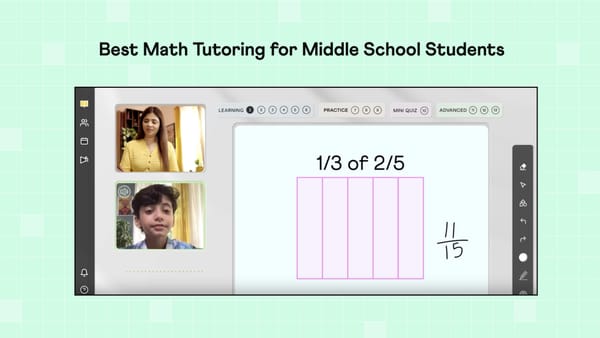
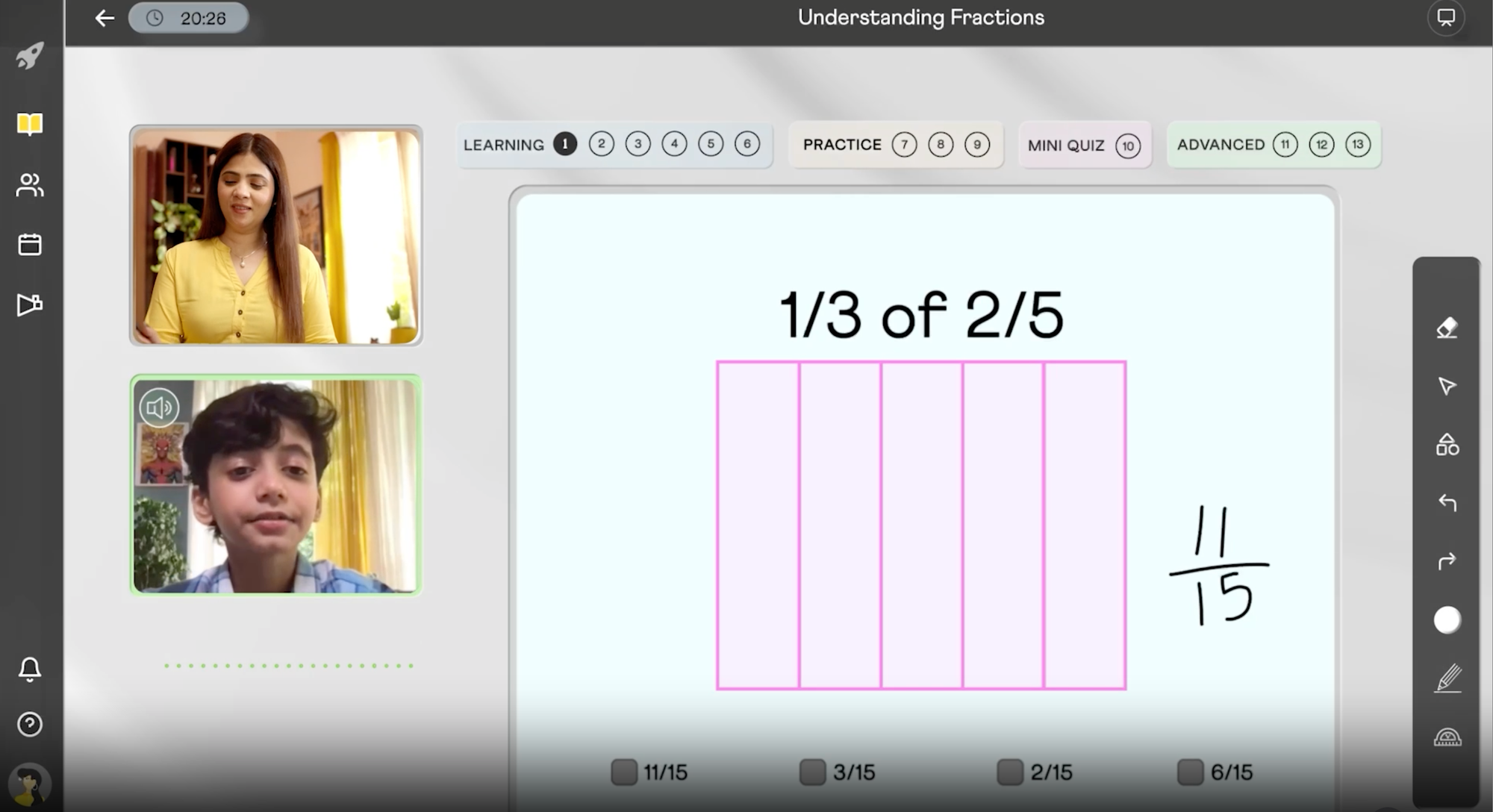
What does this mean? This means that each student is matched with a tutor who is certified to teach elementary math as per US curriculum standards. The classes are conducted on Cuemath's LEAP platform (image below). It is like an interactive whiteboard where the tutor and child solve problems together on screen, and can do anything, draw together, play games, move objects, etc.
What We Found?
For a parent visiting Cuemath for the first time, they can check their elementary segment pages or grade-wise pages. They have pretty much every detail, from their teaching method, reviews, and demo videos of the class. Students also get access to the Cuemath App for daily math games, puzzles, and logic challenges.
Try a Cuemath math game — the same type your child gets access to between sessions:
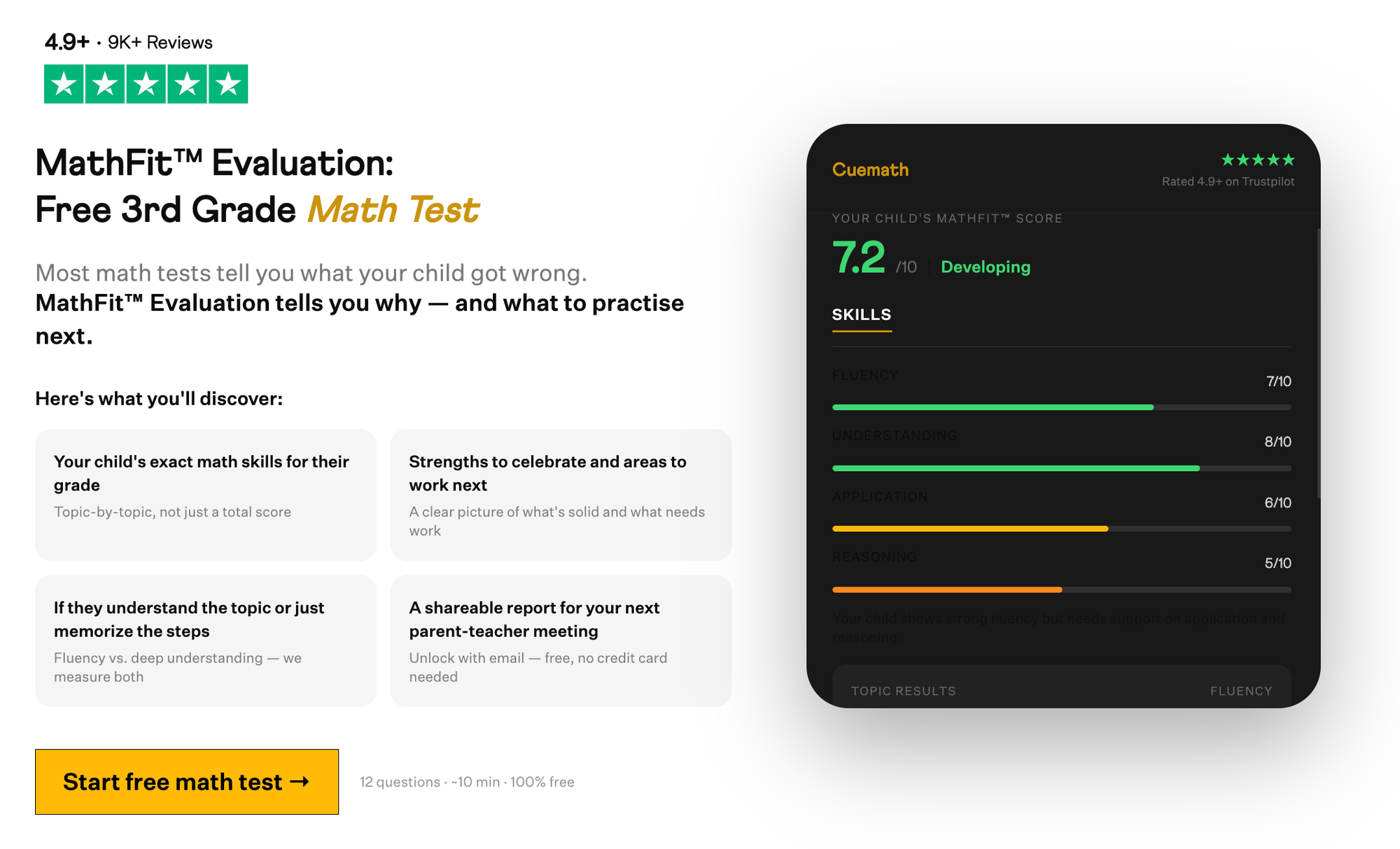
Before signing up, students can take a Free Math Test, which is a pre-assessment covering fluency, understanding, application, and reasoning. For elementary students, this matters more than a grade-level placement: it shows whether a child in 3rd grade is actually missing a 1st-grade concept before the tutor builds a plan.
The same-tutor model was the most consistent theme in parent feedback for this age group. For K–3 students, especially, familiarity with the instructor directly affects whether a child is willing to say "I don't understand," which is the moment real learning happens.
"Ms. Asmita Kukreja helped my child with the transition to US curriculum standards — patient and supportive throughout."
Anand — United States
Verified Trustpilot Review
"My son initially struggled a lot with math. Teacher Kanika's patient, clear explanations transformed him from math-averse to enjoying the subject."
Anjali Verma — United States
Verified Trustpilot Review
Cuemath classes start at $25/class for K-7 students. The cost includes the free MathFit Evaluation, all session tools, and app access between classes. There is no add-on fees.
Learn Real-world Math in Playful Manner
Let your child engage with Cuemath games and learn major concepts. Try a FREE live Cuemath class today.
Book a Free ClassNo credit card needed
Limitation: Tutor quality is not perfectly uniform across all tutors on the platform. A tutor change can be requested with no friction, but the initial match is not guaranteed to be perfect.
Brighterly
| At a Glance | |
|---|---|
| Grades | 1–9 |
| Curriculum | CCSS-aligned |
| Format | Live 1:1 online |
| Cost | 1 month plan starts at $21/class |
| Free Trial | Free first lesson |
| Commitment | Varies by plan |
| Trustpilot | 4.5/5 (600+ reviews) |
Similar to Cuemath, Brighterly is also a 1:1 live online tutoring platform built specifically for Grades 1–9. Not just math, Brighterly gives lessons for both reading and math.
What We Found?
You spend time on their website. You will see grade-wise pages where you have all of the information about the tutors, curriculum, and sample worksheets. The platform is 1:1 math tutoring, but the tutor consistency is the question!
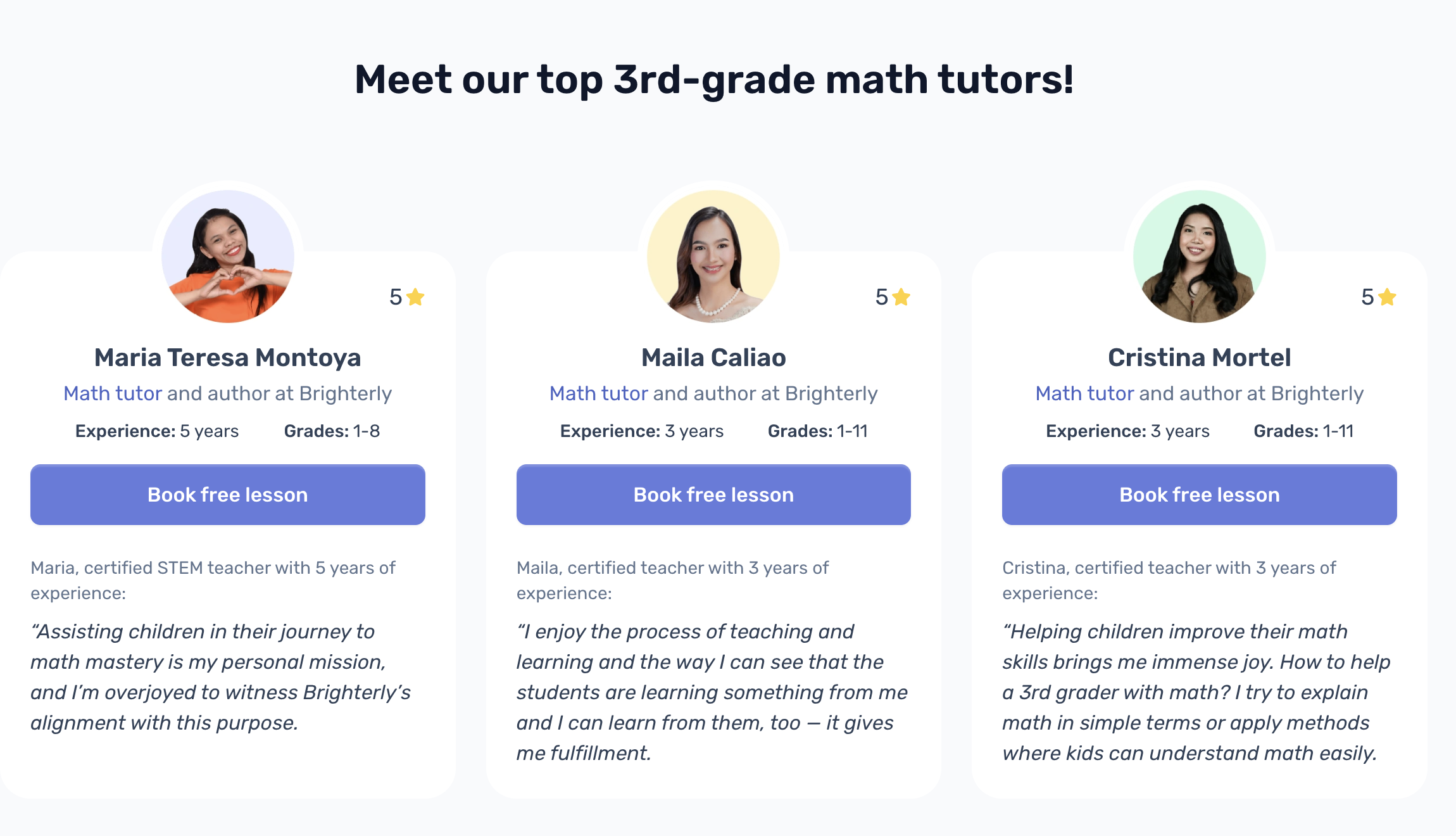
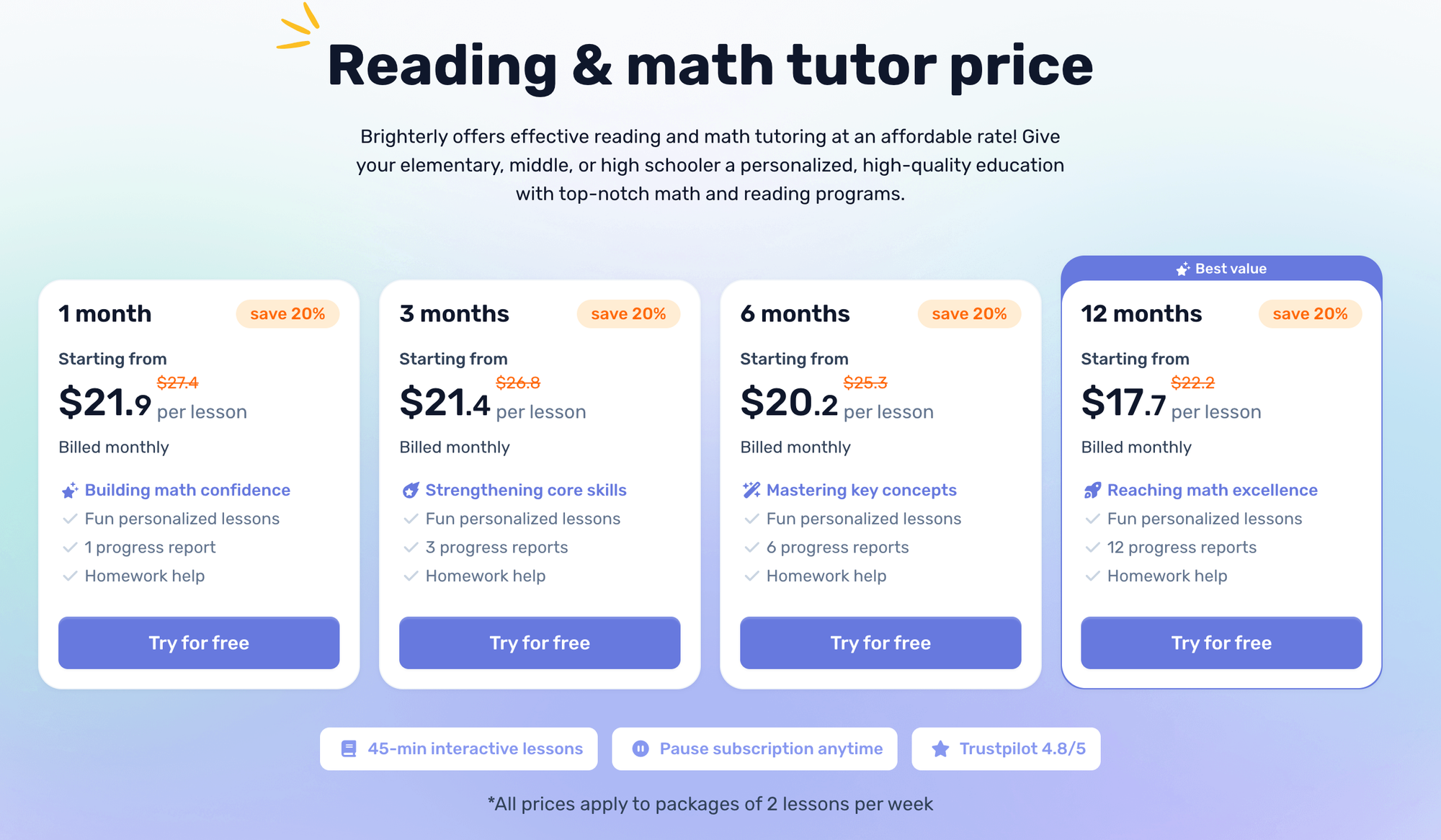
All Brighterly classes and curriculum is built around grade-level math and aligned to US Common Core Standards. Cost-wise also it is quite affordable, the plans start at $21.9 per class. The pricing plans does not mention what all advantages do students get apart from interactive lessons, progress reports and homework help.
Overall, we found a lot of parent comments that mention how they like Brighterly and love how interactive and personalized classes are. We wanted to check if there are any student success stories on the website to tell if Brighterly students achieve greater milestones, but couldn't find any.
B) In-Person Math Tutoring Options
If your child enjoys going out and learning in a group setting, here are the best math tutoring options for elementary students:
Mathnasium
| At a Glance | |
|---|---|
| Grades | K–8 |
| Curriculum | School curriculum-mapped (gap-filling) |
| Format | In-person center (small group, ~1:3–6 ratio) |
| Cost | $250–$450/month (varies by location) |
| Free Trial | Placement assessment included |
| Commitment | Varies by center |
| Trustpilot | Varies by franchise location |
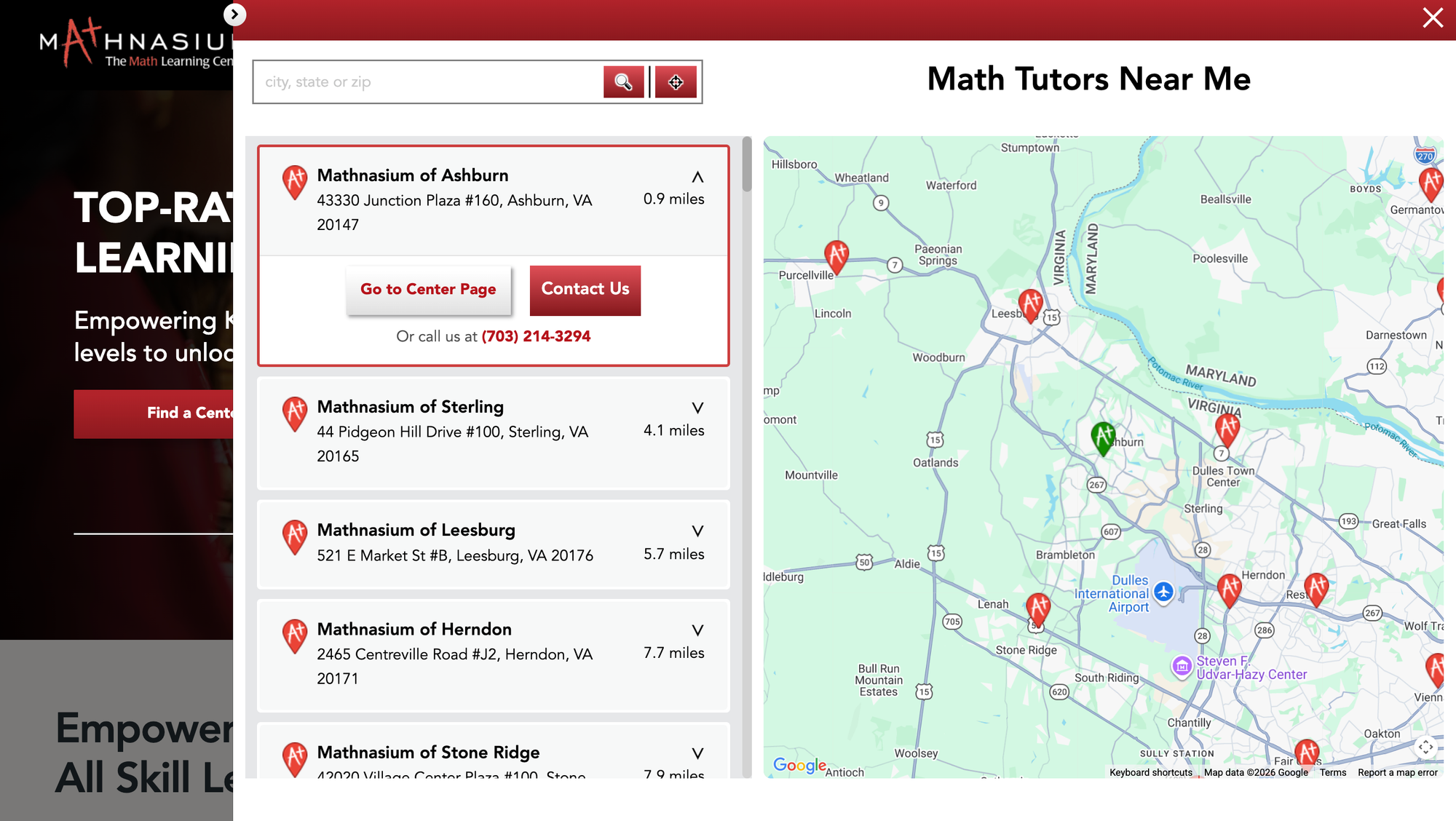
Mathnasium is an in-person math tutoring program with local Mathnasium centers in over 1,000 US locations.
What we found:
We visited 2-3 Mathnasium center websites and reviewed the enrollment process across locations in different states. The placement assessment is the platform's clearest differentiator. It produces a specific gap report before any instruction begins, rather than placing a student by grade level.
However, parent reviews surfaced significant variance in instruction quality by franchise. Parents near centers with experienced staff reported good foundational results; parents near centers staffed primarily by college students described a worksheet-based experience with minimal actual instruction.
“Fixed the specific gaps my 4th grader had — didn't just drill everything.”
✓ r/Parenting, 2025
“We switched locations and it was a completely different experience. The first center was excellent; the second felt like babysitting.”
⚠ r/Parenting, 2025
Did You Know?
Cuemath has one published price for every family in the US — no location variables, no franchise inconsistency, no add-on fees. Starting at $25/class (3-month plan), every session includes:
- True 1:1 live tutoring with the same tutor every class
- A free MathFit Evaluation before the first paid class
- Monthly skill assessments with section-wise scores (Grades 3–8)
- Interactive Cueboard whiteboard and visual manipulatives in every session
- Brain teasers, puzzles, and MathGym app access between sessions
- After-session tutor notes sent to parents after every class
- 100% refund on unused classes
One price. Everything included. Book a free class → · Take the free MathFit Evaluation →
Sylvan Learning
Sylvan Learning wasn't on our radar initially, but repeated mentions in Reddit threads, with mixed opinions, made us take a closer look.
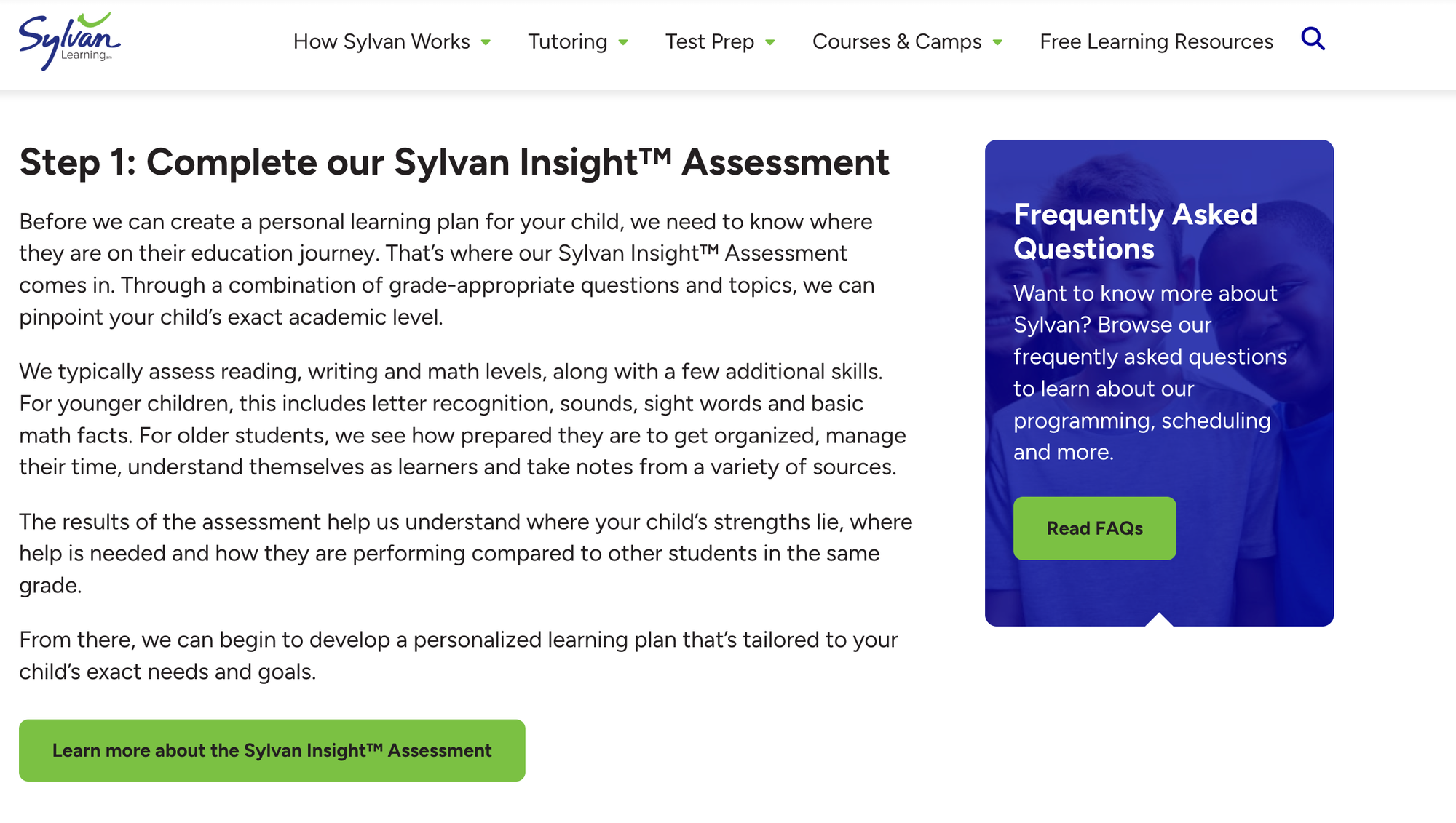
Sylvan operates similarly to Mathnasium: the primary model is in-person tutoring at a local center, with online options also available. Parents have to fill out the contact form, then take the initial Slyvan Insights Assessment, and then, based on it, a personalized learning plan is made. That looks good on paper, but here's what we found.
What We Found?
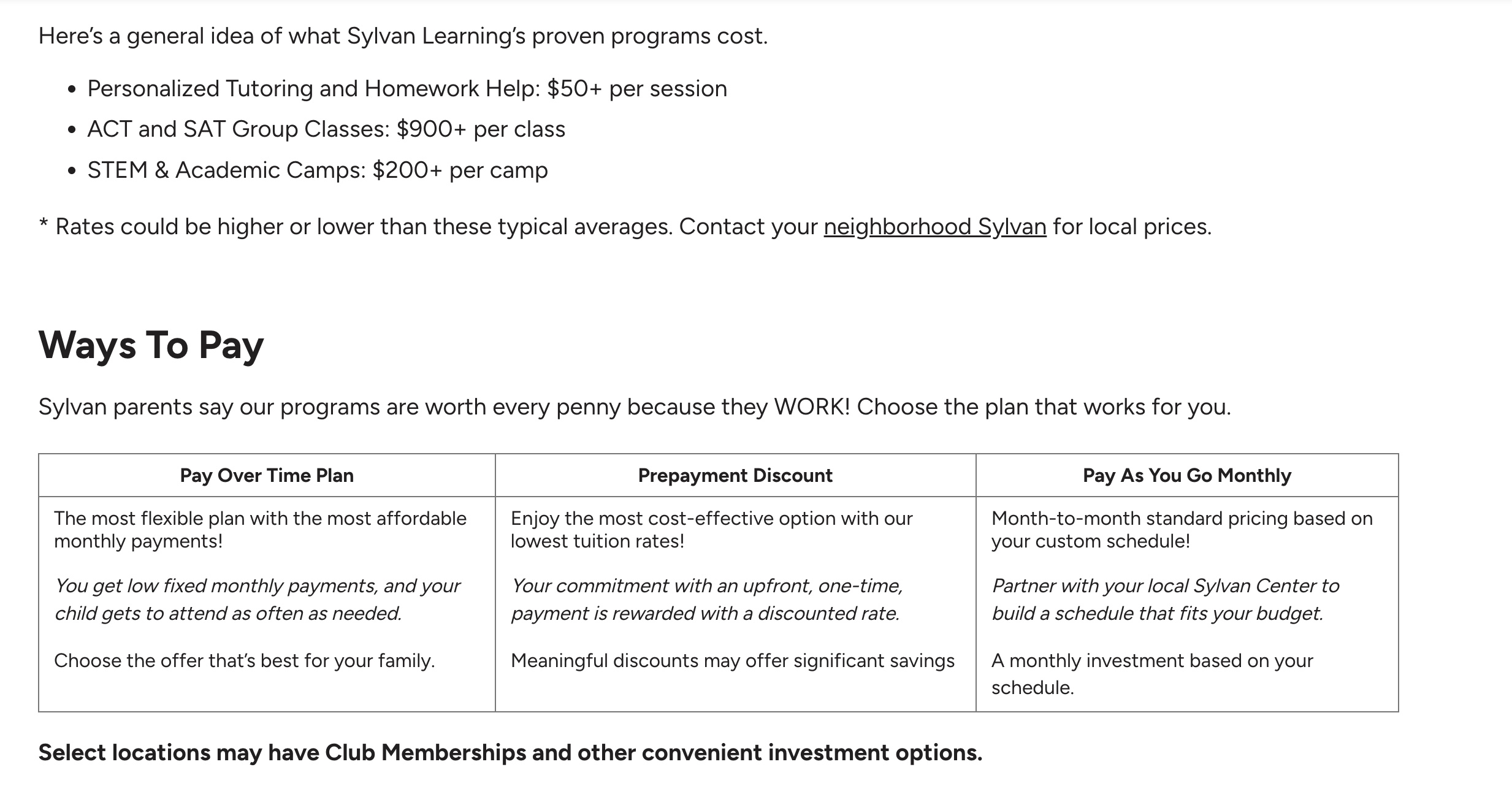
The average pricing is listed at $50 per hour. There is no mention of what it offers apart from tutoring twice a week. There is no proprietary learning platform, interactive tools, or specialized materials to justify the cost.
1:1 Math Tutoring + Test Prep at $25/Class
Give your child the same Cuemath edge that helps thousands of young students make their way to middle school and accelerated pathways ahead. Try a FREE live Cuemath class today.
Book a Free ClassFree Trial + Math Test Available
Sylvan markets itself as 1:1 tutoring, but multiple parents described sessions that felt closer to traditional classroom instruction, scripted, procedure-driven, and without the use of visuals, simulations, or interactive tools that younger learners respond to.
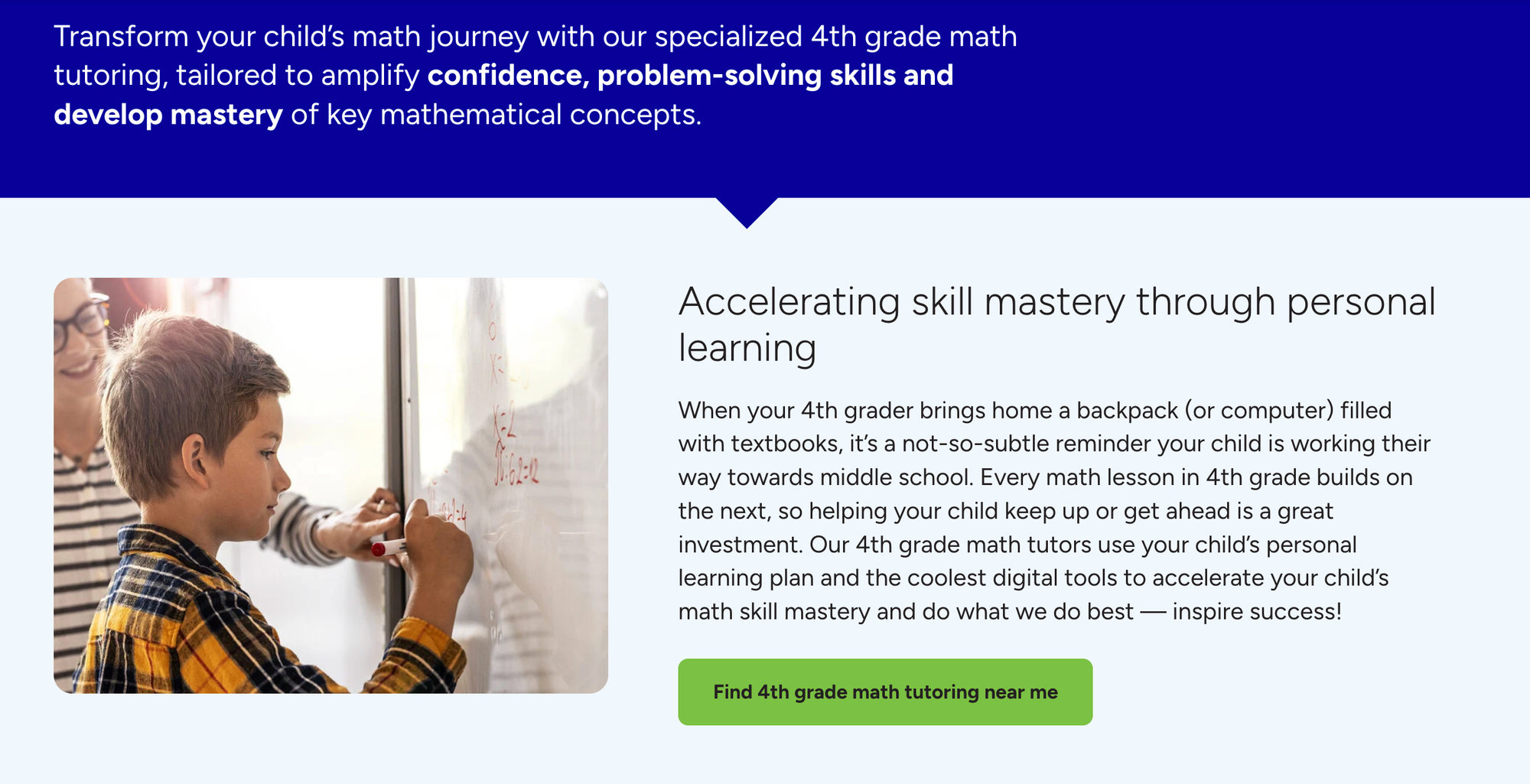
Parents consistently noted that their child's tutor was educated and experienced. The frustration wasn't with the tutors themselves. It was with the company's instructional policies.
That being said, a lot of parents have praised the platform and said there has been a visible improvement in their child's learning journey.
C) Private Tutor Marketplaces
If your child's learning goals are not clear at the moment, and you feel the need to hire tutors for a short period of time without any commitment, here is the best option:
Wyzant
Wyzant's Trustpilot rating is 1.8/5, the lowest of any platform in this guide. Here's what that means for parents, and when it still makes sense.
Tutor Consistency
Wyzant is a marketplace: you search profiles, read reviews, and hire directly. Once you book a tutor, you work with that person consistently.
Curriculum Alignment
A tutor you hire can work directly from your child's school syllabus and homework. Alignment depends entirely on what you ask the tutor to do and whether they follow through.
Personalization
Fully tutor-dependent, no platform diagnostic or assessment. You explain your child's needs; the tutor decides how to approach them.
Engagement
Depends entirely on the tutor you hire.
- Some tutors specialize in young learners and bring games and creative approaches
- Others are subject-matter experts without child psychology training
- Reading individual tutor profiles and reviews carefully is essential
Cost
$40–$120+/hour (tutor-dependent). First session money-back guarantee.
At the per-hour rate, a Wyzant session includes:
- Live 1:1 session with the tutor you selected
- First-session satisfaction guarantee (refund if not satisfied)
- Session notes (if your tutor provides them; not platform-mandated)
Limitation: Trustpilot 1.8/5. At $40–$120+/hour, finding a good tutor by trial and error is expensive.
“Once I found the right tutor on Wyzant, it was exactly what we needed. The pay-by-hour model made it easy to start without a big upfront commitment.”
✓ r/Parenting, 2025
“Finding a good tutor took us four tries. The platform makes it hard to evaluate fit before you pay.”
⚠ r/Parenting, 2025
| At a Glance | |
|---|---|
| Grades | K–12 |
| Curriculum | Tutor-dependent |
| Format | Live 1:1 online or in-person |
| Cost | $40–$120+/hour |
| Free Trial | First-session money-back guarantee |
| Commitment | No ongoing commitment; pay per session |
| Trustpilot | 1.8/5 |
D) Not Tutoring, But Useful Supplements
While these are not tutor-based math tutoring programs, they are still very popular among students because of their unique features. We suggest using these as supplementary tools for elementary school:
IXL
IXL maps to individual CCSS standards at the skill level. Teachers use IXL to assign specific skills aligned with what they are teaching that week.
Parents can see exactly which standard their child is working on and how they perform against grade-level benchmarks.
“IXL's parent dashboard is the most specific progress report I've seen at any price. It showed me exactly which fraction skill my daughter was struggling with, not just 'fractions' in general.”
✓ r/homeschool, 2025
“My 3rd grader cried when her score dropped after one wrong answer. The scoring system punishes mistakes brutally.”
⚠ r/Parenting, 2025
Cost
~$20/month (family plan, all subjects).
At $20/month, IXL includes:
- Unlimited adaptive practice across every K–12 math skill (and other subjects on the family plan)
- Detailed skill-level mastery reports by CCSS standard
- Grade-level benchmark comparisons
- Time-on-task reporting and parent dashboard
Limitation: IXL tells you if you're wrong but never explains why. Use it as a diagnostic layer alongside a live tutoring program, not as a standalone solution.
| At a Glance | |
|---|---|
| Grades | K–12 |
| Curriculum | CCSS-aligned (granular, skill-level mapping) |
| Format | Self-paced adaptive app |
| Cost | ~$20/month (family plan) |
| Free Trial | Limited trial (check website) |
| Commitment | Month-to-month |
| Trustpilot | Not rated as a tutoring platform |
Kumon
Kumon progresses students through arithmetic and fractions in its own sequential order. Parents typically use Kumon as a fluency supplement alongside school, not as a direct school-support tool.
Cost
$150–$200/subject/month + registration fees (typically $50–$75 at enrollment).
Included in a Kumon membership:
- 2x/week center visits
- Worksheet packets to take home for daily practice
- Instructor review of completed worksheets and level advancement tracking
- Sequential progression through Kumon's full arithmetic program
Limitation: Students who do not understand a concept are expected to figure it out through repetition. This can deepen confusion rather than resolve it.
“After 18 months of Kumon, my son does multi-digit multiplication in his head. The repetition works — if your child has the patience and you stay consistent.”
✓ r/Parenting, 2025
“Kumon doesn't teach. If your kid doesn't get it, they just repeat the same worksheet until something clicks — or they quit.”
⚠ r/Parenting, 2025
| At a Glance | |
|---|---|
| Grades | K–8 |
| Curriculum | Sequential number skills (not CCSS week-aligned) |
| Format | In-person worksheets (online version available) |
| Cost | $150–$200/subject/month + registration fees |
| Free Trial | Placement assessment included |
| Commitment | Monthly (center contract varies) |
| Trustpilot | Varies by franchise location |
Beast Academy
Beast Academy covers grades 1–5 content in a way that goes beyond what school typically covers at each grade. It builds mathematical reasoning, logic, and problem-solving skills that complement the school curriculum. The concepts are taught through illustrated comic book characters working through problems.
Cost
$15.99/month (online platform). Physical books are a separate optional purchase at $15–$20 each.
At $15.99/month, the online platform includes:
- Full access to all Beast Academy online content for Grades 1–5
- Comic-style lessons across all topics at each grade level
- Hundreds of puzzle-based problems, logic games, and challenge exercises
- Self-paced level tracking and mastery indicators
Physical books (optional): Guide books (comic narrative) + Practice books (problems), ~$15–$20 per book.
Limitation: Beast Academy is not for students who are struggling or anxious about math. The challenge-first format is a barrier for learners who need foundational support first.
“My 7-year-old asks to do Beast Academy. That's never happened with any math program.”
✓ r/homeschool, 2025
| At a Glance | |
|---|---|
| Grades | 1–5 (online platform) |
| Curriculum | Enrichment and problem-solving (deeper than grade level) |
| Format | Self-paced online + optional comic books |
| Cost | $15.99/month (online); books $15–$20 each |
| Free Trial | Free trial period available |
| Commitment | Month-to-month |
| Trustpilot | Strong parent reviews on Reddit and homeschool forums |
Mathseeds
Mathseeds is specifically designed to feel like play for very young learners. It is deliberately low-pressure and playful; a good first introduction to structured math practice.
Cost
At $14.99/month, Mathseeds includes:
- All animated lessons for Pre-K through Grade 2 math
- Mini-games and reward activities throughout
- Parent dashboard with lesson completion tracking
- Progress reports showing which lessons are complete
- Often bundled with Reading Eggs (reading program) at one combined subscription price
Limitation: Mathseeds does not extend into upper elementary. Its value is as a gentle first step, not a long-term tutoring solution.
| At a Glance | |
|---|---|
| Grades | Pre-K through Grade 2 (ages 3–9) |
| Curriculum | CCSS-aligned early math |
| Format | Game-based online app |
| Cost | ~$14.99/month (or bundled with Reading Eggs) |
| Free Trial | Free trial available |
| Commitment | Month-to-month |
| Trustpilot | Not widely rated independently |
Which program is best for early elementary students (Grades K–2, Ages 5–7)?
Cuemath for live instruction and tutor continuity. Mathseeds is a gentle play-based supplement for ages 5–7.
Which program is best for upper elementary students (Grades 3–5, Ages 8–11)?
Cuemath for 1:1 instruction with monthly assessment. Beast Academy if your child is ahead and need enrichment. IXL is a diagnostic companion to either.
Frequently Asked Questions (FAQs)
What is the best math tutoring program for elementary students?
The best math tutoring program for elementary students depends on what your child needs. For live 1:1 instruction with a consistent tutor and US Common Core alignment, Cuemath is the strongest overall pick for K–5 students. For a curious or advanced learner who needs challenge beyond school, Beast Academy is the strongest enrichment option. For very young learners (Pre-K through Grade 2) who need a gentle first introduction, Mathseeds is well-designed for that age group.
How much does math tutoring for elementary students cost?
Math tutoring for elementary students ranges widely by format. Game-based apps like Mathseeds and Beast Academy cost $14–$16/month. Diagnostic platforms like IXL cost around $20/month. In-person programs like Kumon cost $150–$200/subject/month; Mathnasium runs $250–$450/month. Live 1:1 online tutoring through Cuemath starts at $25/class (3-month plan). On-demand sessions through Skooli run approximately $50/hour. In-person 1:1 tutoring through Sylvan or Wyzant runs $100–$200+/hour.
What should I look for in a math tutor for my elementary child?
For elementary students, the most important factor is tutor consistency: a child who works with the same tutor every class builds the trust and familiarity needed for real learning to happen. Beyond that, look for CCSS curriculum alignment to your child's actual school, an explanation-first approach rather than just right/wrong feedback, and progress reporting after each session so you know what happened in class.
At what age should a child start math tutoring?
Math tutoring is beneficial from Grade 1 (age 6) onward when a child shows signs of difficulty with foundational concepts like number sense, counting, or early addition. Many programs, including Cuemath, serve students from Kindergarten. For very young children (ages 3–5), a play-based app like Mathseeds is often more appropriate than live tutoring. The right time to start is when a gap appears, not after it compounds through multiple grade levels.
Is online math tutoring effective for elementary students?
Yes. Online math tutoring for elementary students is effective when it includes live 1:1 sessions with a real tutor, interactive tools like a digital whiteboard and visual manipulatives, and consistent tutor assignment over time. Programs that are purely video-based or worksheet-driven are less effective for younger learners, who need a human teacher to explain, adjust, and encourage them in real time.
How do I know if my child needs a math tutor?
Signs your elementary child may benefit from a math tutor include: consistently bringing home homework they cannot start independently, expressing that they hate or are afraid of math, scoring below grade level on school assessments, or showing a sharp drop in grades after a topic change (often fractions or multiplication in Grades 3–4). A free MathFit Evaluation from Cuemath can give you a detailed picture of exactly where your child stands across fluency, understanding, application, and reasoning.
How often should elementary students have math tutoring?
Most programs, including Cuemath, recommend 2 sessions per week for elementary students. This frequency builds momentum without creating tutoring fatigue. One session per week can work for a motivated learner who needs light support; twice a week is more effective for students who are behind or working to get significantly ahead.
What is the difference between live tutoring and a math app?
Live tutoring means a real person works 1:1 with your child in real time, sees when they are confused, and adjusts the explanation immediately. A math app delivers preset content with no human present. For elementary students who need instruction, not just practice, a live tutor is significantly more effective. Apps like IXL, Beast Academy, and Mathseeds are strong for specific purposes (diagnostics, enrichment, early exposure) but do not replace live instruction for a child who is struggling.
What is Skooli, and is it good for elementary students?
Skooli is an online tutoring platform that connects students with state-certified teachers for live 1:1 sessions. It operates on a pay-per-minute model (~$0.83/minute), making it flexible for on-demand help without a monthly commitment. For elementary students, Skooli works best for occasional, reactive support: homework help, test prep the night before, or clarifying a specific concept. It is not designed for the kind of consistent, relationship-based tutoring that builds long-term math confidence in young learners.
Is Beast Academy good for elementary students?
Beast Academy is excellent for elementary students who are ahead of grade level or who love math puzzles and challenges. It uses a comic book format to teach mathematical reasoning and problem-solving at a depth that school curriculum typically does not cover. It is not the right choice for students who are behind or anxious about math; the challenge-first format can be frustrating for learners who need foundational support first.
Is IXL good for elementary students?
IXL is a strong diagnostic and practice tool for tracking which CCSS skills an elementary student has mastered and which need work. Its detailed reporting is unmatched at its price point. However, IXL does not teach: it provides no explanation when a student makes an error. The SmartScore error-penalty system can also be demotivating for younger learners. Use it alongside live tutoring, not as a standalone program.
How does Cuemath work for elementary students?
Cuemath provides live 1:1 online math sessions for K–5 students, 55–60 minutes each, with a dedicated tutor assigned from the start. Every student begins with a free MathFit Evaluation to identify gaps across fluency, understanding, application, and reasoning. Tutors use the “cue, don't tell” method: asking questions that help the child discover answers themselves. Starting at $25/class on the 3-month plan, the price includes the MathFit Evaluation, monthly assessments, interactive session tools, access to the MathGym app, and after-session tutor notes — with no add-on fees.
Sources
- Common Core State Standards Initiative — K–5 Mathematics Standards
- National Assessment of Educational Progress (NAEP) — Mathematics Report Card
- Trustpilot — Cuemath Reviews (9,667+ verified parent reviews)
- Trustpilot — Brighterly Reviews
- Art of Problem Solving — Beast Academy Program Overview
- IXL Learning — Common Core Standards Alignment